Sign in




What Is the Normal Transmit Optical Power of a 10G Optical Transceiver? A Look at the Guangruntong (GRT) H-3410FNL-S
< BackWhat Is the Normal Transmit Optical Power of a 10G Optical Transceiver? A Look at the Guangruntong (GRT) H-3410FNL-S
In our daily online customer consultations, we often encounter highly specific and professional questions. Recently, a customer consulting us about the Guangruntong (GRT) H-3410FNL-S 10G 40 km optical transceiver asked a typical question: "What is the normal optical attenuation of this module?"
After consulting with our technical team, we confirmed that the transmit optical power range of the Guangruntong (GRT) H-3410FNL-S optical transceiver is -2 dBm to +4 dBm. It is worth noting that the customer asked about "optical attenuation," while the technical team provided "transmit optical power." Although these two concepts may seem similar, they refer to different technical parameters and deserve clarification.
I. Optical Attenuation vs. Transmit Optical Power: Two Different Concepts
In optical communications, "optical attenuation" and "transmit optical power" are terms that are often confused, even though they have completely different meanings.
Optical attenuation refers to the power loss experienced by an optical signal as it travels through fiber due to absorption, scattering, bending, and other factors. Attenuation is a loss value measured in dB (decibels), indicating the reduction in optical power. The greater the attenuation, the more signal power is lost during transmission and the lower the power received at the far end. In an actual link, attenuation is mainly determined by fiber length, connector quality, splice loss, bending loss, and other factors.
Transmit optical power, on the other hand, refers to the strength of the optical signal emitted by the transmitter of an optical transceiver. It is measured in dBm and is an output performance parameter of the transceiver itself. It determines how far the optical signal can travel and how much link loss it can overcome.
The relationship can be understood as follows: transmit optical power is the signal strength "sent" by the optical transceiver, while optical attenuation is the signal power "lost" during transmission. Therefore:
Received optical power = Transmit optical power − Optical attenuation
When a customer asks, "What is the optical attenuation?", a more accurate question would be, "What is the transmit optical power of this module?" or "What is the acceptable received optical power range?"
II. How Does the -2 dBm to +4 dBm Range Compare?
The transmit optical power range of the Guangruntong (GRT) H-3410FNL-S is -2 dBm to +4 dBm. This value represents the actual optical power at the module's output port and is calibrated during factory testing. How does this range compare with typical specifications?
For long-distance optical transceivers, transmit optical power is generally higher than that of short-range modules to overcome the greater attenuation caused by long-distance fiber transmission. For example, the transmit optical power of 10G single-mode optical transceivers designed for 40 km transmission is commonly specified in the range of 0 dBm to +5 dBm. The -2 dBm to +4 dBm range of the H-3410FNL-S is consistent with typical design standards for 40 km long-distance optical transceivers.
From a link budget perspective, the H-3410FNL-S uses a 1550 nm EML laser and a PIN photodetector, supporting a maximum transmission distance of 40 km. At 1550 nm, the attenuation of standard single-mode fiber is approximately 0.2 dB/km, resulting in about 8 dB of fiber loss over 40 km. Assuming a typical transmit power of +2 dBm, the received optical power would be approximately -6 dBm after subtracting the 8 dB fiber transmission loss. This is higher than the H-3410FNL-S receiver sensitivity of -14 dBm and lower than its overload point of 0.5 dBm, placing it within the module's normal operating range with sufficient link margin.
In addition, the H-3410FNL-S features Digital Diagnostic Monitoring (DDM/DOM), which can monitor key parameters in real time, including transmit optical power, received optical power, temperature, voltage, and bias current. Operations personnel can read DDM data through a switch or network adapter to verify whether the current transmit power is within the specified range of -2 dBm to +4 dBm and whether the received optical power is within a safe range. If transmit power remains abnormally low or bias current rises significantly, the module's aging trend can be identified in advance to help prevent unexpected link failures.
III. Practical Recommendations for Network Operations Personnel
For operations personnel using the H-3410FNL-S, the following points are worth noting.
First, during short-distance loopback testing, such as over a few meters, fiber attenuation is almost negligible. As a result, the received optical power may approach or even exceed the module's overload point. For the H-3410FNL-S, the overload point is 0.5 dBm. An appropriate optical attenuator must therefore be installed at the receiver to prevent receiver saturation or damage.
Second, regularly read transmit and received optical power through DDM, compare the values against the specifications, and establish baseline data for future troubleshooting.
Third, when CRC errors or packet loss occur, first check whether the received optical power is below the sensitivity threshold. This is often more efficient than replacing equipment without a clear diagnosis.
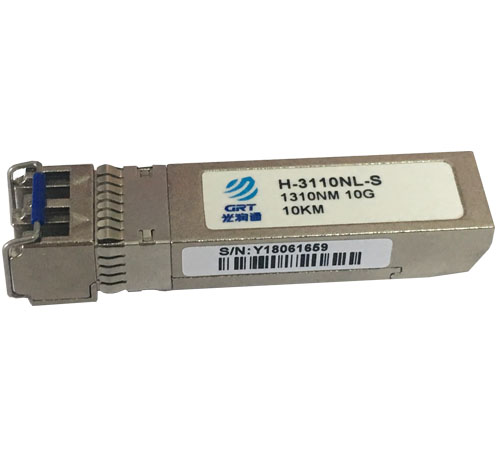
The Guangruntong (GRT) H-3410FNL-S is a 10G 40 km single-mode optical transceiver featuring an SFP+ package, 1550 nm wavelength, duplex LC interface, 10 Gbps data rate, and DDM digital diagnostics. Its transmit optical power range of -2 dBm to +4 dBm complies with industry standards for long-distance transmission. After extensive compatibility testing, it can interoperate reliably with switches and network adapters from major brands.
For more information about product specifications or technical support, please contact us through the official Guangruntong (GRT) website or our sales channels.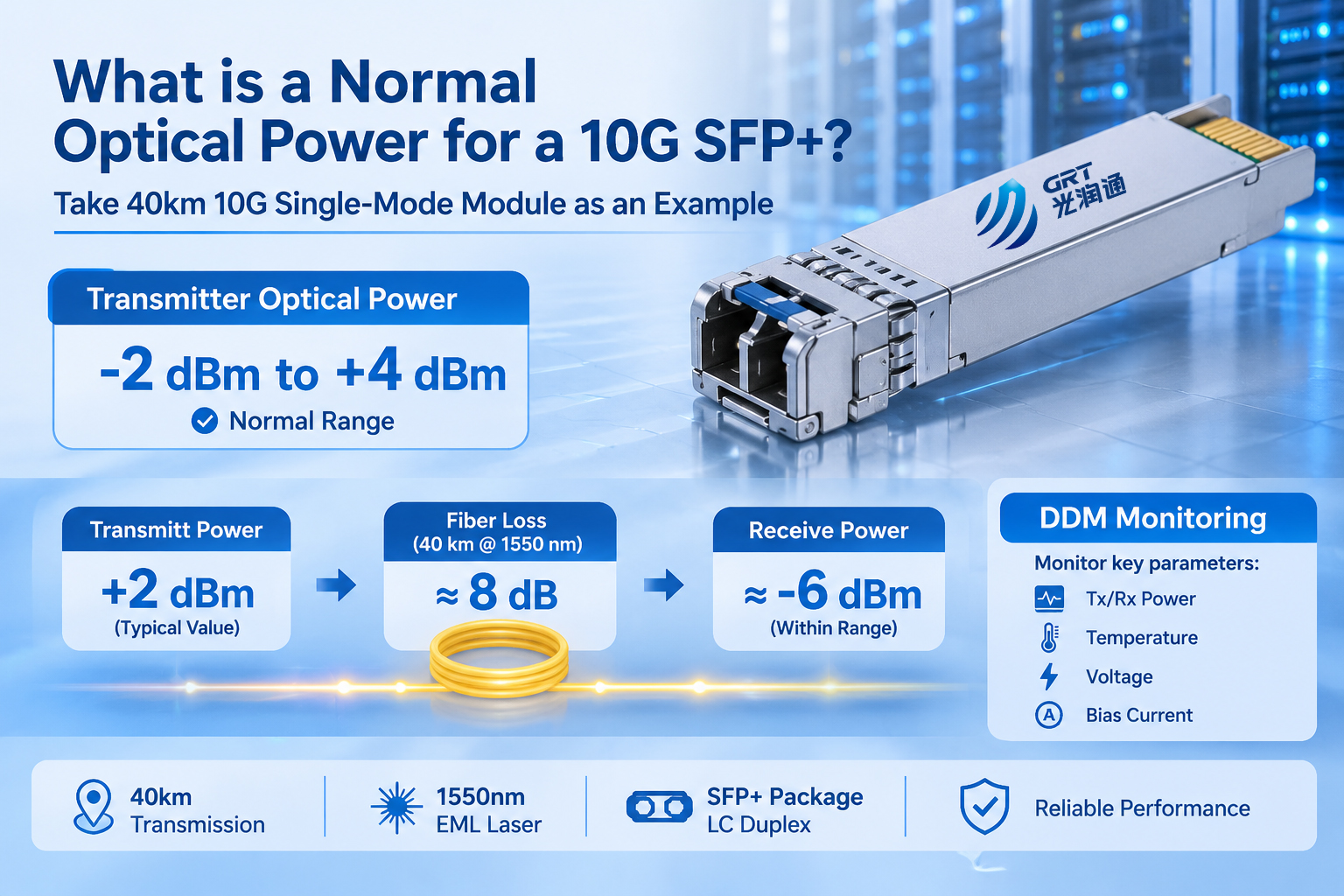
Latest information
- Core Differences Between NIC Redundant Link Functionality and Bypass NICs
- How to Monitor Laser Bias Current to Predict Optical Module Aging
- What Is the Normal Transmit Optical Power of a 10G Optical Transceiver? A Look at the Guangruntong (GRT) H-3410FNL-S
- AC Coupling Capacitors: Small but Essential Components in High-Speed PCIe Signaling
- GRT 200G Multimode Optical Transceiver
- Network Troubleshooting
- Wavelength Division Multiplexing: Enabling Fiber Optics to Carry More Data
- How PCIe Interfaces Affect Signal Integrity